Mortgage modernization: why previous attempts have failed


Despite decades of innovation and billions in technology investment, every attempt to modernize mortgage origination has followed the same arc: a promising new technology arrives, gets absorbed into the existing assembly line, improves a specific task, adds integration complexity, and fails to significantly reduce overall costs.
Digital applications, APIs, point solutions, and AI tools have each delivered real value within narrow domains. But collectively, they have left the mortgage factory’s fundamental architecture intact, its coordination overhead growing, and its per-loan costs climbing from $7,046 in 2015 to $12,579 by Q1 2025.
This pattern is not coincidental. What follows is a look at the four major innovation waves of the past 15 years, and the structural conditions that explain why each was absorbed by the assembly line rather than replacing it.
Digital applications
When Rocket Mortgage launched in late 2015, it introduced something genuinely new: a consumer-facing digital application that promised approval in as little as eight minutes. Borrowers could complete applications on their phones, upload documents via camera, and track loan status in real time. Within five years, digital applications had become an industry standard.
But the limited reach of this innovation soon became apparent. Borrower data entered through the digital point-of-sale system still required manual re-entry into the loan origination system. Processing still involved collecting hundreds of pages of documentation across email, portal uploads, and fax. Underwriting still meant manual “stare and compare” review. Third-party services still required coordination through separate vendor portals. The front end had been digitized, but the assembly line behind it was unchanged. Origination costs continued their climb, and closing timelines held steady at 30 to 45 days.
The lesson was straightforward: digitizing how data enters the system doesn’t help when the system itself still depends on sequential human handoffs to move that data from station to station.
Point solutions
Venture capital poured into mortgage technology throughout the 2010s, funding hundreds of startups focused on specific pain points: income verification, employment verification, asset verification, fraud detection, document preparation, pricing engines, hedging tools, quality control, and compliance automation.
Each tool addressed a real problem and delivered measurable improvements within its domain. Income verification services could analyze bank statements in minutes rather than hours. Document preparation automated the generation of disclosure packages. Pricing engines provided real-time rate sheets from multiple investors.
But each tool also added to the integration burden. Enterprise lenders now maintained 15-20 separate vendor solutions, each requiring licensing fees, implementation, training, and ongoing support. Typical per-loan costs for these tools added up quickly: $100 to $300 for the LOS platform, $50 to $150 each for point-of-sale and pricing engines, $75 to $150 for document preparation and compliance, $100 to $200 for verification services, and $50 to $100 for post-close quality control. In addition to external vendors, large lenders developed extensive portfolios of internal applications to support their mortgage operations.
The deeper problem was that these systems rarely shared data natively. Each vendor maintained its own data model and its own approach to organizing loan information. IT teams spent enormous resources building point-to-point integrations, and a change to one system often broke connections to others. Human workers increasingly became the integration layer: the people who manually moved information between systems, reconciled discrepancies, and resolved the gaps. Operations teams could find themselves spending as much time coordinating between systems as processing loans. The same data might be validated multiple times across different platforms before a loan could move forward.
The pattern repeated: each point solution made a specific task faster, but added another system to integrate, another vendor to manage, another seam where human coordination was required. The more technology got layered onto the assembly line, the more coordination the assembly line demanded.
APIs
As fintech matured, mortgage technology vendors rushed to claim they were “API-first.” In practice, most of these APIs offered limited functionality within a single vendor’s ecosystem rather than true interoperability across the mortgage stack.
The Mortgage Industry Standards Maintenance Organization (MISMO) had been developing data exchange standards since its founding in 1999. These standards were widely adopted in name but implemented inconsistently. Each vendor interpreted the standards differently, added proprietary extensions, or supported only subsets of the full specification. The result was the appearance of interoperability without its true benefits.
No single player had the authority or incentive to impose true standardization. Large lenders lacked the technical capability to build a complete platform and couldn’t force vendors to open their APIs. Dominant vendors like ICE, whose Encompass LOS holds substantial market share, had little reason to enable interoperability that might reduce switching costs. ICE’s click-fee model, which charges lenders each time they access vendor information through the platform, illustrates how the fragmented architecture created revenue streams that depended on its continuation. Smaller vendors couldn’t achieve the scale to become platforms. And the government-sponsored enterprises, despite their market power, focused on underwriting standards rather than technology infrastructure.
Enterprise lenders reported facing costs of $5 to $10 million or more to migrate from one LOS to another, including data migration, reintegration, staff retraining, and operational disruption. This switching cost entrenched existing systems regardless of whether superior alternatives existed, further reducing competitive pressure for meaningful innovation.
AI tools
The emergence of cost-effective large language models and generative AI has sparked the most consequential wave of mortgage technology innovation yet. AI capabilities have advanced rapidly: document extraction that once required manual review can now be performed with high accuracy by machine learning models. Natural language processing can interpret complex guidelines. Automated systems can evaluate borrower data against investor requirements in seconds rather than days.
This wave is different from its predecessors in one important respect: the underlying technology is, for the first time, capable of performing the judgment-heavy work that has kept humans at the center of the assembly line for eight decades. Parsing unstructured financial documents, interpreting ambiguous guidelines, handling edge cases, and making consistent credit decisions are no longer tasks that only humans can perform.
Yet for most of the industry, the pattern is repeating. Lenders are deploying AI tools for document classification, fraud detection, income calculation, and borrower communication, but deploying them within the same fragmented infrastructure that limited every previous wave of innovation. AI-powered point solutions are being bolted onto existing LOS platforms, integrated through the same brittle point-to-point connections, and operated by the same specialized departments. The tools are more powerful, but the architecture they sit within is unchanged.
Industry leaders have noted the gap. A December 2025 National Mortgage News analysis observed that AI’s capabilities already far exceed how mortgage professionals are currently applying the technology, and that the challenge is less about what AI can do than about how organizations manage the transition. A January 2026 survey by The Mortgage Collaborative found lenders increasingly interested in “agentic AI” to reduce origination costs, yet still operating within assembly-line workflows that constrain what any individual tool can achieve.
The question is whether AI will follow its predecessors into the graveyard of half-measures, or whether the technology will finally force a reckoning with the architecture itself.
The conditions that locked the industry into incrementalism
Each of these innovation waves was absorbed by the assembly line for reasons that were, at the time, entirely rational. Four structural conditions explain why.
Human judgment had no substitute. Until recently, software simply could not perform the kind of complex, contextual reasoning that mortgage origination requires. Underwriting involves reviewing hundreds of pages of unstructured financial documents, interpreting guidelines containing subjective language, and making holistic credit decisions on cases that defy standard patterns. Processing requires judgment about which documents are acceptable. And closing requires coordination among parties with different systems and requirements. Given this constraint, optimizing the existing assembly line was the only viable path. Every innovation wave from digital applications to early AI tools followed this logic: make human workers faster and more accurate, since software could not do the work for them.
No single player could solve the fragmentation problem. Transformation would have required industry-wide coordination to establish common data standards, open APIs, and shared infrastructure. But the mortgage ecosystem consists of thousands of independent companies with different technology stacks, business models, and competitive incentives. MISMO’s standards were adopted inconsistently. Dominant vendors profited from complexity. Integration providers earned revenue maintaining connections between systems. A unified platform that eliminated integration work would have destroyed significant revenue streams across the ecosystem. The fragmentation persisted because too many participants benefited from the status quo.
Economic incentives rewarded incrementalism. Each new point solution promised marginal efficiency gains in a specific area while requiring manageable implementation effort. These incremental bets fit within annual budgets and could be reversed if they didn’t deliver. Completely replacing the technology stack, on the other hand, would mean 12 to 24 months of operational disruption, tens of millions of dollars in implementation costs for larger lenders, and uncertain payoff. The few companies that attempted radical transformation illustrated the difficulty: Better.com invested heavily in technology but has yet to achieve sustained profitability. Rocket Mortgage spent over a decade building its platform. The risk-reward calculation consistently favored incrementalism.
Risk aversion was rational, not irrational. Independent mortgage banks lost an average of $1,056 per loan in 2023, with some quarters seeing losses exceed $2,000 per loan. In this environment, pursuing incremental improvements was a matter of survival, not a failure of vision. Mortgage origination is a high-stakes, time-sensitive process where a system outage during a rate lock period could cost millions. The downside of a failed transformation attempt was existential, while the upside of success looked like a competitive advantage, not a lifeline. The industry sought 10 percent improvements when 10x transformation was needed, but 10 percent improvements were all that seemed feasible given the constraints.
What’s changed
While these four conditions have limited mortgage innovation for decades, they aren’t fixed.
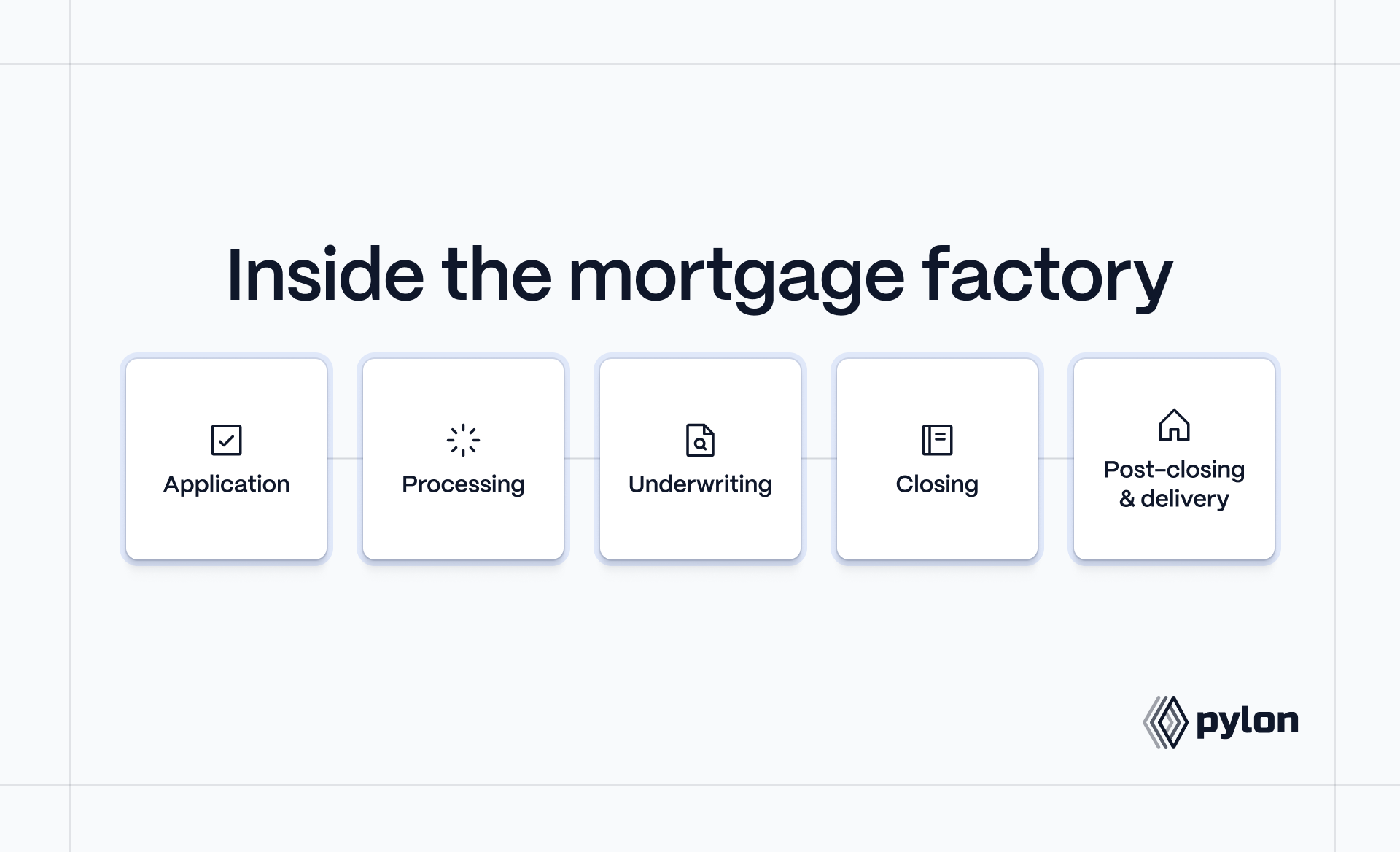
The first and most consequential constraint, the irreplaceability of human judgment, has been largely removed. Advances in AI have produced systems capable of parsing hundreds of pages of financial documents with high accuracy, interpreting complex and ambiguous guidelines, handling the edge cases that once required experienced human reviewers, and making consistent credit decisions at a speed and scale that human-staffed assembly lines cannot match. For the first time, the technology exists to collapse application, processing, underwriting, closing, and delivery into a single software-driven workflow.
The fragmentation problem, while still present for incumbents, is no longer an obstacle for new entrants building from scratch. A platform designed from the ground up around a unified data model and encoded guidelines doesn’t need to integrate with 15 legacy vendors or reconcile data across disconnected systems. The coordination tax that consumes so much of today’s $12,000 per loan simply doesn’t apply if there is no assembly line to coordinate.
This doesn’t mean the transition will be instant or painless. Regulatory requirements, investor guidelines, and the sheer complexity of mortgage transactions remain real. But the structural conditions that made the assembly line the only viable architecture are rapidly falling away. For the first time, the mortgage industry will be able to choose between continuing to layer technology onto the old assembly line, and building an entirely new kind of infrastructure designed for the capabilities of 2026.
Sources
Mortgage Bankers Association. “IMBs Report Slight Production Losses in First Quarter of 2025.” May 16, 2025.
Mortgage Bankers Association. “Independent Mortgage Bankers Post Net Production Profits in 2024.” April 17, 2025.
Mortgage News Daily. “Mortgage Banking Profits Increased in 2016.” April 13, 2017.
Freddie Mac. “2024 Cost to Originate Study.” 2024.
HousingWire. “ICE solidifies position as the dominant player in the mortgage tech space in 2023.” December 22, 2023.
National Mortgage News. “AI improvements make 2026 pivotal for mortgage adoption.” December 31, 2025.
Scotsman Guide. “Survey: Lenders increasingly turn to AI and automation to curb costs and drive growth.” January 30, 2026.