Inside the mortgage factory: how mortgages get made

The average cost to originate a mortgage reached $12,579 per loan in 2025, a 75% increase from just a decade ago. Rather than delivering better credit decisions or faster closings, that extra money goes toward coordinating the dozens of people, systems, and vendors that the industry’s assembly line model requires.
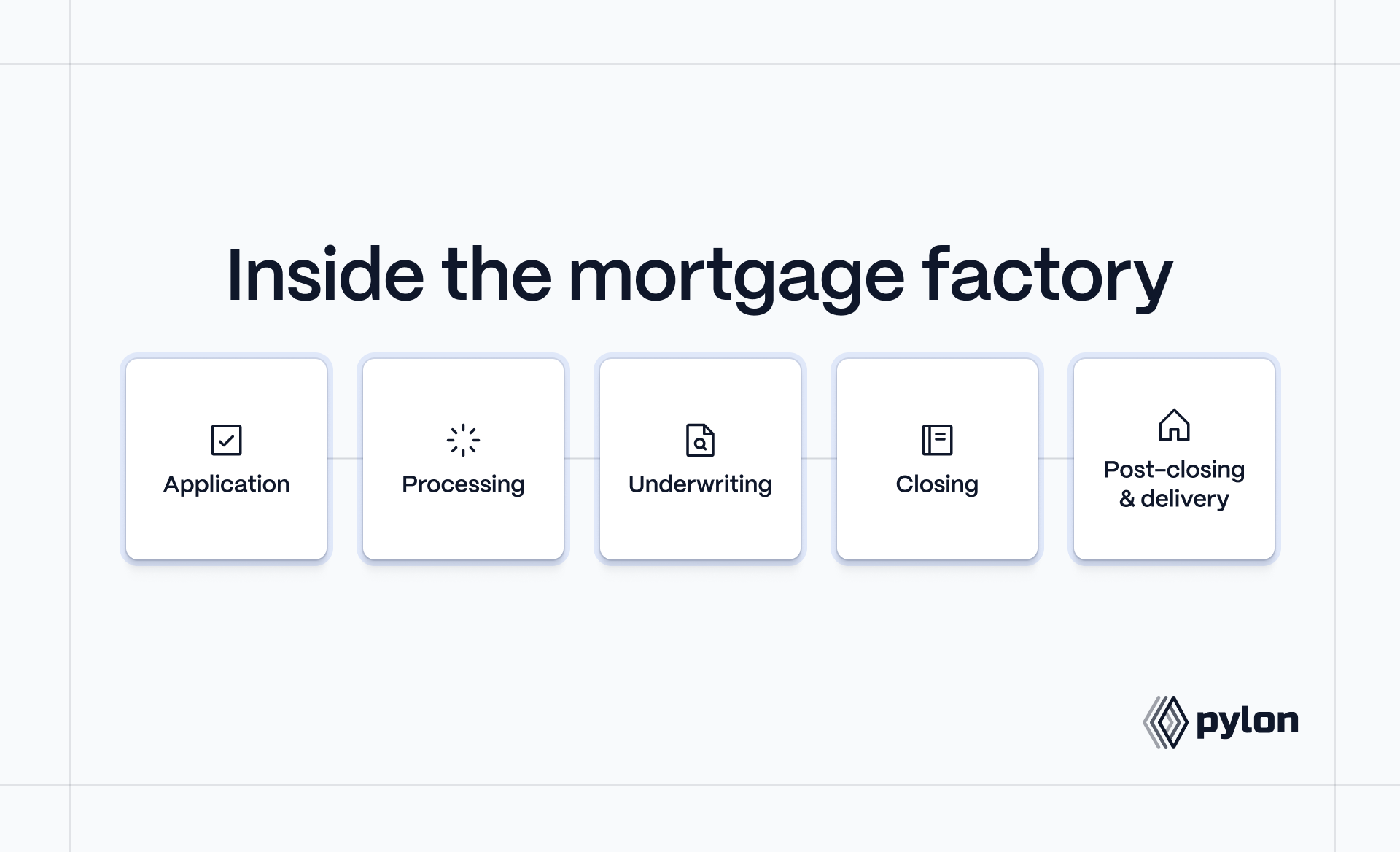
The assembly line model was first introduced in the 1940s and still defines how almost every mortgage gets made today. Applications move from intake to processing to underwriting to closing, passing through specialized departments at each stage. While workflows vary across retail, broker, correspondent, and bank/credit union channels, this sequential, department-based structure remains the dominant architecture of mortgage production. Over the decades, new technologies have been layered on top (automated underwriting systems, compliance engines, digital point-of-sale platforms), but the underlying structure remains unchanged. Sequential stages, specialized departments, fragmented systems, and manual handoffs are still facts of life for originators.
What follows is a look under the hood at each station on the assembly line: where complexity accumulates, where costs compound, and why the model has resisted every attempt to fix it from the inside.
Application and initial setup
The mortgage begins when a borrower submits an application, either through a digital point-of-sale system (POS), over the phone with a loan officer, or some combination of the two. What seems like a single event actually triggers a cascade of manual work.
A setup team or loan officer creates the official loan file in the lender’s loan origination system (LOS), the central database that tracks the loan through every subsequent stage. Even when the POS and LOS are ostensibly integrated, this step often requires re-entering data that the borrower already provided. The file is then submitted to an automated underwriting system (AUS) like Desktop Underwriter or Loan Prospector, which evaluates the borrower’s creditworthiness against program guidelines and returns findings within minutes. These findings, however, are advisory rather than binding; human underwriters will revisit them later.
Then comes the ordering of third-party services: property appraisal, title policy, flood certification, employment and income verifications, IRS tax transcript requests, and homeowners insurance verification. Each service runs through a separate vendor portal or requires phone-and-email coordination. Most vendors maintain their own systems with no integration to the lender’s LOS, so each order means more manual data entry (property information, borrower details, loan specifics) typed into yet another interface.
Of these third-party services, the property appraisal is often the most consequential. An appraiser must physically visit the property, which introduces scheduling dependencies. Appraisal turnaround times vary widely by market, ranging from a few days in some areas to two weeks or more in others. If the appraisal comes back below the expected value, it can trigger renegotiation between buyer and seller, require a second opinion, or force a restructuring of the loan, sending the file backward through steps that were already complete.
Setting aside appraisal timelines, the initial setup work alone typically consumes 2–3 business days, much of it queue time. Each vendor must be contacted separately. Status updates are tracked through phone calls and emails. Results arrive in varying formats and must be manually uploaded into the LOS. The first station on the assembly line sets the pattern for everything that follows: technology handles discrete tasks efficiently, but humans bear the full weight of stitching those tasks together.
Documentation and pricing
After setup, a loan processor takes ownership of the file and begins gathering documentation from the borrower. For a typical mortgage, this means collecting hundreds of pages of information: pay stubs, W-2s, bank statements, tax returns for self-employed borrowers, retirement account statements, gift letters, divorce decrees, child support documentation, and property-related records.
These documents arrive through every channel imaginable: email attachments, POS portal uploads, fax transmissions (still common), and physical mail. The processor reviews each document for completeness and accuracy, classifies it, extracts key data points, and uploads it to the correct location in the LOS. Documents frequently arrive incomplete or in the wrong format, sending the processor back to the borrower for resubmission. Making matters worse, documents expire: bank statements older than 60 days become invalid, pay stubs older than 30 days must be replaced. A slow borrower can put a processor on a treadmill.
Most processors manage 50-100 active files simultaneously, each at a different stage, each with its own outstanding items. Context-switching is constant.
Running parallel to documentation is pricing. A pricing desk or loan officer pulls current rate sheets from multiple investors, applies lender-specific overlays based on credit score, loan-to-value ratio, and other risk factors, and runs calculations through third-party pricing engines. This work repeats throughout the life of the loan: at application, when market conditions shift, when borrower circumstances change, and again when the borrower is ready to lock.
Woven into this pricing work is the rate lock decision. Once a borrower locks, the clock starts: a typical lock period of 30 to 60 days sets a hard deadline for closing. If the loan isn’t funded before the lock expires, the borrower faces re-lock fees, altered pricing, or both. The lock period effectively turns every downstream delay into a cost risk. A file stuck in the conditions loop, a slow appraisal, a missing document: each one burns lock days that cannot be recovered. While the lock exists to protect the borrower from market volatility, in practice it can become another source of pressure on a process already struggling to keep pace with its own complexity.
Underwriting and the conditions loop
Once documentation is assembled, the loan file moves to underwriting, and into what is arguably the most consequential bottleneck in the entire process.
The underwriter performs what the industry calls “stare and compare”: manually reviewing documents and cross-referencing information across the file. Do pay stubs match W-2s? Do bank statement deposits align with reported income? Is employment stable? Are credit report details accurate? The underwriter calculates debt-to-income ratios, evaluates whether the property type meets program requirements, and flags anything that doesn’t add up.
The review itself takes 1-3 days. But the review is only the beginning.
Most loans receive conditional approval, meaning the underwriter has identified issues that must be resolved before final sign-off. These conditions get documented in the LOS, which triggers a notification to the processor, who contacts the borrower, waits for a response, uploads new documentation, and notifies the underwriter that the file is ready for another look. Each round of this cycle can take days. Complex files can go through multiple rounds, each one resetting the clock.
This conditions loop is often where loans spend the majority of their time after the initial credit decision, and it reveals one of the core inefficiencies of the assembly line: that the model separates decision-makers from document gatherers, creating an asynchronous back-and-forth across departments and systems. Guidelines are applied retroactively by human reviewers rather than encoded into the workflow from the start. Requirements that could have been surfaced to the borrower on day one instead emerge piecemeal, days or weeks into the process, through intermediaries who are juggling dozens of other files.
The conditions loop is largely a product of the assembly line itself, not an inherent feature of mortgage complexity.
Closing
After final underwriting approval, a closing specialist takes over and begins orchestrating the most coordination-intensive stage of the process.
The closer assembles a document package of 100-200 pages: the promissory note, deed of trust, final Closing Disclosure, and dozens of additional required forms. They coordinate scheduling among the borrower, seller (for purchases), real estate agents, title company representatives or closing attorneys, and notaries. They ensure closing funds are wired correctly between multiple banks and accounts, and that all parties sign the right documents in the right places.
Federal regulations add timing constraints. Borrowers must receive the Closing Disclosure at least three business days before closing. Any significant change to terms, whether a last-minute fee adjustment or a payoff amount correction, triggers a new three-day waiting period. The closer is essentially a project manager coordinating multiple independent parties who use different systems and communication methods, all converging on a single deadline with regulatory guardrails that penalize any misstep.
Post-closing and delivery
The borrower signs, gets the keys, and moves on. But the assembly line has two more stations.
A post-closing team or third-party QC vendor conducts a detailed quality control review: verifying that signatures appear in all required places, dates are correct, documents contain no errors or omissions, loan amounts and terms match disclosures, and all third-party documents are properly executed. This review adds 5-10 days during which the loan cannot be sold and the lender’s capital remains tied up. Any issue (a missing signature, a calculation error, a documentation gap) must be resolved before the loan can move forward, sometimes requiring contact with borrowers who have already closed.
Finally, the post-closing team prepares the loan for delivery to investors. They organize documentation according to investor-specific requirements, which vary significantly between Fannie Mae, Freddie Mac, Ginnie Mae, and private investors. Data must be manually entered into investor-specific portals (Desktop Originator, Loan Selling Advisor, Ginnie Mae systems) even though this information already exists in the LOS. Trailing documents can extend this phase 30 or more days after closing.
The loan has finally completed its journey through the assembly line.
Why the assembly line is so expensive
Stepping back from the details, a pattern emerges. The mortgage factory’s primary job isn’t to evaluate credit or assess property values. It’s to coordinate the movement of information between the people, systems, and vendors who perform those tasks. The assembly line is, at its core, an elaborate and expensive coordination mechanism. (It should be acknowledged that post-crisis regulatory expansion has added real complexity to mortgage production, but much of that complexity is amplified by how work is structured and handed off across departments.)
Each handoff between departments introduces queue time while work waits for the next available specialist. Each system boundary requires manual data transfer. Each specialist context-switches between dozens of active files. Each round of the conditions loop adds days of elapsed time. A processor spending hours tracking appraisal status through vendor portals isn’t adding value to the credit decision; they’re compensating for system fragmentation. An underwriter requesting documents multiple times isn’t performing deeper analysis; they’re absorbing the cost of asynchronous communication across departments. A post-closing team catching missing signatures isn’t improving quality; they’re finding errors that continuous validation would have prevented.
This is the efficiency paradox that has confounded the industry for decades. Each new point solution makes a specific task faster, but adds another system that must be integrated, another vendor portal that must be monitored, another seam where human coordination is required. The more technology gets layered onto the assembly line, the more coordination the assembly line demands. Costs rise not just despite technology investment, but also because of it.
What the assembly line makes visible
Walking through the origination process station by station reveals something that cost figures alone cannot: the mortgage factory’s problems aren’t located at any single station. No one department is the bottleneck. No one system is the weak link. The cost and complexity emerge from the connections between stations, from the handoffs, the queue times, the data re-entry, the conditions loops, the vendor coordination.
This is why decades of targeted automation have failed to bend the cost curve. Optimizing individual stations doesn’t address the coordination tax that accumulates between them. A faster AUS doesn’t help when the file sits in a processing queue for three days before reaching underwriting. Automated document classification doesn’t help when the conditions loop still requires a processor to chase borrowers via email for missing paperwork. Electronic signatures don’t help when the post-closing team still manually reviews 200 pages for errors that could have been caught in real time.
The technology to eliminate this coordination work already exists. Guidelines can be encoded into software that validates data continuously rather than retroactively. Document requirements can be generated automatically based on loan characteristics and surfaced to borrowers directly. Third-party services can be orchestrated through APIs rather than coordinated through phone calls and vendor portals. The conditions loop can be collapsed by building guideline validation into the workflow from the first keystroke.
But none of this is possible within the assembly line framework. These aren’t incremental improvements to existing stations. They represent a fundamentally different architecture, one where the coordination layer that consumes so much of today’s $12,000 per loan simply doesn’t exist.
Adjacent industries have already demonstrated what this kind of transformation looks like. Insurance underwriting that once took weeks now evaluates risk in minutes. Payment processing that relied on checks and multi-day transfers now settles in seconds. Consumer lending that required branch visits and manual review now closes instantly on a mobile device. None of these transformations happened by making the old process faster. They happened by making the old process unnecessary.
The mortgage assembly line has served its purpose for 80 years, albeit with steadily growing costs. Now that we’ve seen exactly how it works, and where the $12,000 per mortgage actually goes, the interesting question becomes what a post-assembly-line world can look like when this coordination tax no longer applies.
Sources
Mortgage Bankers Association. “IMBs Report Slight Production Losses in First Quarter of 2025.” May 16, 2025.
Mortgage News Daily. “Mortgage Banking Profits Increased in 2016.” April 13, 2017.
ICE Mortgage Technology. Origination data reported in multiple industry publications, June–August 2025.
Rocket Mortgage. “How long does it take to close on a house?” September 30, 2024.
Consumer Financial Protection Bureau. “What documentation do I need to provide when applying for a mortgage?”
Consumer Financial Protection Bureau. “What is a Closing Disclosure?”
Bankrate. “What Is The Mortgage Loan Origination Process?” August 15, 2025.
OpsDog. “Mortgage Origination Process Flow Charts & Workflows.”
Mortgage Cadence. “Why Task-Based Loan Origination Is Reshaping Mortgage Lending.” June 30, 2025.
Finastra. “How Workflow Automation Transforms Mortgage Lending.” August 6, 2025.
Dark Matter Technologies. “Accelerating mortgage origination with task-based workflows.” May 30, 2024.